Describe to me what a sacrament is.
Historically in the life of the church...for protestants we've usually meant baptism...and communion.
A sacrament is a means of grace...in which we discover God is present with us in powerful ways. And we engage in these practices because we understand and believe that God has promised to meet us in these sacraments.
Can we start understanding evangelism as a sacrament?
I think about two scriptures. Of course there's the Great Commission. Jesus said Go...baptizing them and teaching them. He said that clearly as a commandment.
The other is I think about Paul's commandment...faith comes by hearing.
God is not telling us to pass on information. He's challenging us to bring people to Him.
I think that's the way we really ought to see it.
What are the key ways to evangelize?
I think first of all, the most effective evangelist layperson that I've encountered...were people that saw evangelism not just as their own private enterprise. They saw it as a community of faith that they were a part of.
They weren't just trying to pick people off one by one....instead they viewed their calling as inviting people into the church.
Those people also realized that we're not first and foremost called to speak the gospel. But we're called to live it out in our lives.
How do we balance evangelism and compassion?
If a person actually deeply cares about the welfare of another human being, we're of course going to care about whether they have enough to eat. But also about whether or not they have the bread of life.
We're going to be concerned about whether they have clothes to wear. But also whether they are clothed in righteousness.
If you have the love spread in your heart, you care about the unborn baby.
I think it begins with whether we have the love of God spread about in our hearts.
If we have a discerning heart, if someone's hungry, we're going to figure out how to address that.
Do we contextualize evangelism - do it differently depending on location?
In the small town evangelism, there is an awareness of people's lives that you don't have in the anonymity of New York City.
It seems more of this relational, going out with your neighbors, caring for your neighbors to be ready to give a reason for why you help the poor.
In New York City, I would think that just stopping to care for people in the anonymous morass of the city.
Matt Friedeman: Husband, dad, professor, pastor, author, prison chaplain, pro-life activist.
Friday, April 29, 2011
Pastors Circle - Steve Blakemore
Thursday, April 28, 2011
The Missing Link of Discipleship
Here is my latest in the AFA Journal:
Years ago in the Wall Street Journal, Martin Marty wrote an article on evangelicalism. These were the headlines:
- An Evangelical Revival is Sweeping the Country, But with Little Effect- Shunning the Sinful World- Effect Has Been Small- Shying From Involvement
Ouch. I tell my students at the seminary where I teach that “If you make disciples by sitting around and talking, don’t be surprised if your disciples sit around and talk.”
The truth of the matter is that active service is part and parcel of the discipleship strategy of Jesus and the greatest missing element of modern discipleship.
We prefer to make disciples in small groups, hunkered over our Bibles and our lattes, asking each other provocative questions about the biblical text. A really good study leader might encourage us to go and apply the truths in our lives this week. But one thing we don’t do – we don’t serve together regularly.
Do you suppose Jesus, after demonstrating for us His discipleship model, might wonder Why not?
The gospel of Matthew, the most “rabbinic” of the accounts of Jesus, tells us that Jesus began to call his disciples to Himself (4:18-22). In chapters five through seven comes the Sermon on the Mount, where Jesus adds fresh perspective to everything the disciples probably already thought they knew.
But here’s the problem – in Scripture, the Sermon is not what comes directly after the disciples’ call. This is what follows:
Jesus went throughout Galilee, teaching in their synagogues, proclaiming the good news of the kingdom, and healing every disease and sickness among the people. … people brought to him all who were ill with various diseases, those suffering severe pain, the demon-possessed, those having seizures, and the paralyzed; and he healed them (4:23-25).
This sort of thing happens throughout the Gospels. Jesus calls His disciples together and He teaches them, to be sure. But He does it in the context of touching the untouchables of their culture and asking His disciples to do the same. He teaches them in “Bible study” moments, but He is downloading kingdom content amidst service to the desperate in His community.
This is so basic a truth, it is astonishing that Sunday school classes, small group Bible studies, families and whole churches miss it. If Jesus made disciples with service, for service, then how can we possibly emulate His method with biblical content minus activity together?
The problem is particularly acute, I suspect, with our families. God has called us to make disciples – primarily, I feel, with our own children. Two different experts in youth ministry recently interviewed on my radio show cited research indicating that if you want to keep your kids interested in church long after they have left your home, it is essential to serve with them, and not just now and then. “Go do something regularly heroic,” said one researcher, “and bring your kids along.”
Teaching your children a biblical worldview is important, as so many Christian ministries remind us today. But inculcate that world-view without some kind of concomitant world-do and you might have inadvertently conveyed how irrelevant the Bible and church can be to the prevailing culture.
One can almost sense the disdain that pours forth from the pen of Luke as he writes of those ready to dismiss the message of Paul: “All the Athenians and the foreigners who lived there spent their time doing nothing but talking about and listening to the latest ideas” (Acts 17:21).
Not choosing. Not doing. But talking. And listening. A sure recipe for discipleship disaster if it ends with an application of mouth and ears but not hands and feet. Read the rest...
Monday, April 25, 2011
Rigorous theology
David Brooks saw a Broadway production called The Book of Mormon. The conclusion of his column is long, but well worth reading.
Dean Kelly once wrote a book called Why Conservative Churches Are Growing. Many thought theologically conservative churches were hopelessly ill-equipped to serve the modern world, yet it was the theologically liberal churches who did everything they could to position themselves to serve contemporary society that floundered. Why? One of the main thoughts seem to be simple - conservative churches demand something from their adherents. Rigorous theology...
The religions that thrive have exactly what “The Book of Mormon” ridicules: communal theologies, doctrines and codes of conduct rooted in claims of absolute truth.
Rigorous theology provides believers with a map of reality. These maps may seem dry and schematic — most maps do compared with reality — but they contain the accumulated wisdom of thousands of co-believers who through the centuries have faced similar journeys and trials.
Rigorous theology allows believers to examine the world intellectually as well as emotionally. Many people want to understand the eternal logic of the universe, using reason and logic to wrestle with concrete assertions and teachings.
Rigorous theology helps people avoid mindless conformity. Without timeless rules, we all have a tendency to be swept up in the temper of the moment. But tough-minded theologies are countercultural. They insist on principles and practices that provide an antidote to mere fashion.
Rigorous theology delves into mysteries in ways that are beyond most of us. For example, in her essay, “Creed or Chaos,” Dorothy Sayers argues that Christianity’s advantage is that it gives value to evil and suffering. Christianity asserts that “perfection is attained through the active and positive effort to wrench real good out of a real evil.” This is a complicated thought most of us could not come up with (let alone unpack) outside of a rigorous theological tradition.
Rigorous codes of conduct allow people to build their character. Changes in behavior change the mind, so small acts of ritual reinforce networks in the brain. A Mormon denying herself coffee may seem like a silly thing, but regular acts of discipline can lay the foundation for extraordinary acts of self-control when it counts the most.
“The Book of Mormon” is not anti-religious. It just endorses a no-sharp-edges view of religion that is all creative metaphors and no harsh judgments. The Africans in the play embrace this kind of religion. And in the context of a hilarious musical, that’s fine.
But it’s worth remembering that the religions that thrive in real-life Africa are not as nice and naïve as the religion in the play. The religions thriving in real-life Africa are often so doctrinaire and so socially conservative that they would make Pat Robertson’s hair stand on end.
I was once in an AIDS-ravaged village in southern Africa. The vague humanism of the outside do-gooders didn’t do much to get people to alter their risky behavior. The blunt theological talk of the church ladies — right and wrong, salvation and damnation — seemed to have a better effect.
Dean Kelly once wrote a book called Why Conservative Churches Are Growing. Many thought theologically conservative churches were hopelessly ill-equipped to serve the modern world, yet it was the theologically liberal churches who did everything they could to position themselves to serve contemporary society that floundered. Why? One of the main thoughts seem to be simple - conservative churches demand something from their adherents. Rigorous theology...
Friday, February 25, 2011
A pro-life question: Why not more pastors...?
"Why aren't more pastors involved in this?" asked one of my friends standing with me outside an abortion clinic.
I told him we were happier preaching and staying respectable in the eyes of the world and our parishoners than we were in activating the faith.
Then we asked someone else who was standing out there. Doug said that most churches are outreach oriented in the first place and, second, most churches who are will start ministries that are easier and more compatible with traditional emphases than, say, abortion clinic ministry. If that is ever added, it will be added to a much larger mix of outreach and compassionate efforts.
He is probably right.
But the abortion clinic ministry was our first ministry at our decade old church. Then we added all the rest.
What a backward bunch I serve with!
I told him we were happier preaching and staying respectable in the eyes of the world and our parishoners than we were in activating the faith.
Then we asked someone else who was standing out there. Doug said that most churches are outreach oriented in the first place and, second, most churches who are will start ministries that are easier and more compatible with traditional emphases than, say, abortion clinic ministry. If that is ever added, it will be added to a much larger mix of outreach and compassionate efforts.
He is probably right.
But the abortion clinic ministry was our first ministry at our decade old church. Then we added all the rest.
What a backward bunch I serve with!
Why all the anger towards Christians?
Is it possible that a dearth of Christ-like characteristics -- such as integrity, holiness, forgiveness, compassion -- among believers is turning off "the world" to Christianity?
OneNewsNow.com a few years ago asked its Internet readers: What is the primary cause of the increasing animosity toward Christianity?
Readers said:
On the talk-radio show that I host, I asked the audience if a sixth answer might be appropriate. How about "Christians"? Could believers themselves be the primary cause of the "increasing animosity"?
OneNewsNow's poll was unscientific by polling standards. So were the answers to the talk show inquiry. But that day on the airwaves, 100% agreed that the Church has caused negative perceptions by:
The audience thought so -- integrity, for starters.
I once participated in a televised, four-person panel discussing my community -- Jackson, Mississippi. The city council was in disarray as the president of the council and another councilman were headed off to jail. The council president, for his part, had made a behind-the-back deal with a strip club for the purposes of a re-zoning ordinance, was caught and found guilty of the crime, and was subsequently sent to a correctional facility.
The moderator, a local newscaster named Katina Rankin, looked at me during the give-and-take and, trying to get a rise out of me, asked, "Matt, whose fault is all of this?"
Mission accomplished. I suddenly became agitated. My face began to get red and I prepared to launch into a tirade about how we are a nation of laws and how the city council president had looked at that law, trampled on it, and tried to get some cash flow he had no right to have as a public official. If we were looking for culprits there was only one place to put the blame -- smack dab in the council president's lap as he sat in his well-deserved jail cell.
That is what I was going to say.
But I never got the words out. One of the panelists sitting next to me was a gentleman named John Perkins -- author, teacher, community developer, national evangelical leader, Christian statesman. As my index finger stiffened and my blood pressure rose, I prepared to answer Ms. Rankin when Dr. Perkins intervened before I got a word out.
"It's my fault," he answered Rankin.
All heads, quizzically, turned his way.
"I have lived in this community for decades as a Bible teacher," he said. "I should have been able to create an environment where what our council president did would have been unthinkable because of my efforts.
"You want someone to blame? I'll take the blame."
You could have heard a pin drop. Part of the silence was mine as I reflected on my own lack of involvement.
Whose fault? Our fault. And that is something we can change.
OneNewsNow.com a few years ago asked its Internet readers: What is the primary cause of the increasing animosity toward Christianity?
Readers said:
Anti-Christian media (39.58%)
Liberal public education (30.61%)
Political correctness (13.59%)
Indifference to religion (11.63%)
Anti-Christian politicians (4.59%)
On the talk-radio show that I host, I asked the audience if a sixth answer might be appropriate. How about "Christians"? Could believers themselves be the primary cause of the "increasing animosity"?
OneNewsNow's poll was unscientific by polling standards. So were the answers to the talk show inquiry. But that day on the airwaves, 100% agreed that the Church has caused negative perceptions by:
- Lackadaisical response and/or silence in the face of national moral decline
- Mirroring the world's values
- Rank hypocrisy -- we talk a good talk, but our walk is well worth criticizing
- Powerless living
- Anemic involvement in addressing the nation's problems
The audience thought so -- integrity, for starters.
- Talk holiness, but live it even more.
- Forgive those who wrong you and wrong the culture.
- Reach out to the unlovable and the "untouchables" of our age with Christ-like compassion.
- Quit saying that prayer is the most important thing and act like it really is.
- Be humble.
I once participated in a televised, four-person panel discussing my community -- Jackson, Mississippi. The city council was in disarray as the president of the council and another councilman were headed off to jail. The council president, for his part, had made a behind-the-back deal with a strip club for the purposes of a re-zoning ordinance, was caught and found guilty of the crime, and was subsequently sent to a correctional facility.
The moderator, a local newscaster named Katina Rankin, looked at me during the give-and-take and, trying to get a rise out of me, asked, "Matt, whose fault is all of this?"
Mission accomplished. I suddenly became agitated. My face began to get red and I prepared to launch into a tirade about how we are a nation of laws and how the city council president had looked at that law, trampled on it, and tried to get some cash flow he had no right to have as a public official. If we were looking for culprits there was only one place to put the blame -- smack dab in the council president's lap as he sat in his well-deserved jail cell.
That is what I was going to say.
But I never got the words out. One of the panelists sitting next to me was a gentleman named John Perkins -- author, teacher, community developer, national evangelical leader, Christian statesman. As my index finger stiffened and my blood pressure rose, I prepared to answer Ms. Rankin when Dr. Perkins intervened before I got a word out.
"It's my fault," he answered Rankin.
All heads, quizzically, turned his way.
"I have lived in this community for decades as a Bible teacher," he said. "I should have been able to create an environment where what our council president did would have been unthinkable because of my efforts.
"You want someone to blame? I'll take the blame."
You could have heard a pin drop. Part of the silence was mine as I reflected on my own lack of involvement.
Whose fault? Our fault. And that is something we can change.
Thursday, February 24, 2011
Looking BOTH ways in life...a word study
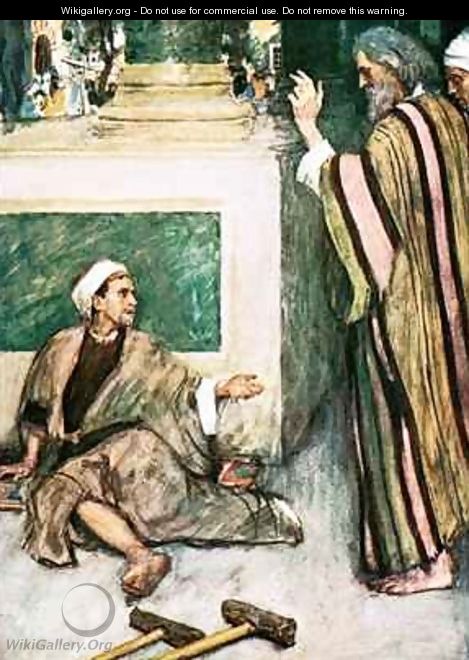
Preached on Acts 3 on Sunday. It is the story of God healing the crippled beggar through Peter and John. Luke says that "Peter looked straight at him" which is an interesting word in the Greek pronounced a-te-NEE'-zow.
It is used 14x in the NT, twice by Paul, twice by Luke in the Gospel and 10 times in Acts. Every usage in Acts seems instructionally significant. The first two times a-te-NEE'-zow is used is the believers "looking intently" up into heaven. Godward. Second time - Peter and John "looking straight" at the beggar. Toward human need.
Good lesson here. To look Godward is symbolic of the first of Jesus' two great commandments "Love God with all your heart, soul, mind, strength." To look toward human need seems symbolic of "Love your neighbor as yourself."
I once thought it was easy for Christians to think heaven all day without being moved toward those in need of our compassion. I no longer think so. The vast majority of those who call themselves "Christian" have no vital prayer life, are largely scripturally illiterate and are theologically inept. Most also don't take seriously the hurting in their midst.
But the abundant life is found right there taking looking intently with eye and hand with the weekly warp and woof of our lives.
It is used 14x in the NT, twice by Paul, twice by Luke in the Gospel and 10 times in Acts. Every usage in Acts seems instructionally significant. The first two times a-te-NEE'-zow is used is the believers "looking intently" up into heaven. Godward. Second time - Peter and John "looking straight" at the beggar. Toward human need.
Good lesson here. To look Godward is symbolic of the first of Jesus' two great commandments "Love God with all your heart, soul, mind, strength." To look toward human need seems symbolic of "Love your neighbor as yourself."
I once thought it was easy for Christians to think heaven all day without being moved toward those in need of our compassion. I no longer think so. The vast majority of those who call themselves "Christian" have no vital prayer life, are largely scripturally illiterate and are theologically inept. Most also don't take seriously the hurting in their midst.
But the abundant life is found right there taking looking intently with eye and hand with the weekly warp and woof of our lives.
Pastor's Circle - Steve Griswold, prison chaplain
Would you concede that prisoners for the most part deserve the incarceration?
After you finished seminary, why did you choose the prison chaplaincy?
What is the root cause of the problem?
How many are repeat offenders?
Would you say that they need strong men in their community to back them up when they're released?
Are there success stories?
Are addictions a significant issue?
They didn't get there by chance. The incarcerated men have gone through a long period of sin and bad decisions that has wound up with them in prison.
After you finished seminary, why did you choose the prison chaplaincy?
I was asked to go to the prison but I didn't feel real comfortable. I had been praying that I would see people as God saw them, and that my heart would break over the things that break God's heart. And He showed me that the men in there were my brothers.
What is the root cause of the problem?
The initial problem is the fatherlessness rate. If we can change the direction of these young and even not-so-young men and get them to deal with their children as godly men, perhaps we can change the trend.
How many are repeat offenders?
About 80%. A lot of them get picked up for misdemeanors, and when they get out, it interferes with their abilities to get and hold legitimate jobs, which leads them back to their old illegitimate behavior. Many of them end up living on the streets.
Would you say that they need strong men in their community to back them up when they're released?
I think that is the answer. That's one of the things that I preach in there is that they need to find a good church that's going to love them and back them up and preach the gospel to them.
Are there success stories?
In my experience, yes. In my church there are more and more men who get out of prison and return to their families. Some of them are even moving into my church's town to join in with us there.
Are addictions a significant issue?
90% of the inmates are there from an addiction problem. But the addictions are just the band-aid that they put over the spiritual wounds.
Wednesday, February 23, 2011
Author: Collin Hansen, "Don't Call it a Comeback"
Collin Hansen is a contributor to the book on evangelicals called Don't Call it a Comeback."
Why do you call the book "Don't Call It A Comeback"?
What is evangelicalism?
As you look back, who puts this thing together the best?
Is today's evangelical church healthy?
Not many people seem to be striving for sanctification anymore. Is this cause for great concern?
Will the younger generation be able to get excited about the local church?
Why do you call the book "Don't Call It A Comeback"?
It's a bit of a cheeky reference to a song that was big in the 80s, but the idea is that there are a lot of people today saying that we need a new faith, and we need to change things about our tradition, because a lot of things just aren't "believable" anymore.
What is evangelicalism?
Evangelicalism is a vibrant expression of Christian faith today. A lot of people will trace it back to the 1700s and people like George Whitfield, Jonathan Edwards, etc.
But what we try to show here is that this faith is rooted in Scripture itself, rooted in the early councils that decided things like the nature of the Trinity and the divinity of Jesus, and all the way through Martin Luther, John Calvin, and up to today.
As you look back, who puts this thing together the best?
I think by God's grace, every Christian figure you look back on in history is a failure in some way. You read about this great men of God, and they all messed up one way or another.
Their teaching was true in that it accorded with Scripture, but they fell short in many ways.
I learned a lot from people like John Wesley, John Calvin, and Jonathan Edwards. Despite theological differences, they all call you back to the same thing.
I think that's the way the evangelical movement is. We always call people back to the same gospel.
Is today's evangelical church healthy?
I think there are a lot of aspects of it that are very healthy.
It's dangerous when people say, "You have to do this program," or "You have to shed that doctrine." I think be always wary of people who say your church is gonna fall apart unless you do ____.
The Lord is going to preserve his church. When the Church is in danger, that's when people realize their need for God and go to him for help.
Not many people seem to be striving for sanctification anymore. Is this cause for great concern?
Yes. I think to be truly authentic is to be able to connect with others, and to be open about your life.
But there's not much of an effort to reach for holiness.
I think the goal is to pursue it in t he right manner.
It's when we appreciate Jesus' dying for us, and the same poer that raised Jesus from the daea, it's then when we can receive holiness.
Will the younger generation be able to get excited about the local church?
The key is community. People are longing to be part of something bigger than themselves.
Young people find it in social media, but ultimately that's not a fulfilling sort of community. What we need is that life-on-life, face-to-face interaction with people.
They're turned off a lot by the hypocrisy they see in the Church, but one thing I hope they realize is that the Lord works in us despite all that.
The problem is not everyone else in the local church, the problem is me in the church. I'm a sinner like everyone else.
It's discouraging to see how many are put off by the local church, but I think the community is what will draw people back.
Pastor's Circle - Keith Drury, Indiana Wesleyan University
Keith Drury is Associate Professor at Indiana Wesleyan University. Check out www.tuesdaycolumn.com.
You wrote something last month: The 6 stages of outrage against evil. Tell us about those.
What does it tell us about the human psyche that we always want to moderate?
You've talked about standards in your writing. Are we a better or lesser church for all our rules?
You wrote something last month: The 6 stages of outrage against evil. Tell us about those.
I've noticed that churches move through stages that start with absolute outrage and end up with acceptance.
I used alcohol as an example. There was the Prohibition, then we decided that Christians shouldn't do it, then it was our tradition that didn't, then it was "unwise", then questionable, and finally not even an issue.
I just wanted to provoke the church to think about things like this.
What does it tell us about the human psyche that we always want to moderate?
I think in the Church we get weary. At some point, you just don't have the muscle to enforce prohibition.
It's compromise, in a way. That's the negative term for it.
In other ways, it's just adaptation to the world we live in.
You've talked about standards in your writing. Are we a better or lesser church for all our rules?
I have a hunch that every time we let one down, we add one.
There's different kinds of new prohibitions in the church.
My old church had no stance on abortion at all. We've now moved into issues like environmentalism.
I've wondered if it's maybe a zero-sum game. You win one, you lose one.
Tuesday, February 22, 2011
Pastor's Circle - Father Albert Haase on "The Image of God"
In your counseling and your dealings with people, is there something you've noticed that prevents people from understanding God?
Is it possible to go the other way?
How is it possible to get a healthy image of God
You are a former missionary to China. What is the image of God to the Christian in China?
In my teachings, just recently I had the rare opportunity to speak at the Moody Bible Institute. One of the things I was telling Moody was that a lot of people have unhealthy images of God. When we have that, it's going to affect everything about how we relate to God.
When we are continually fearful and frightened, we really haven't encountered the Abba Father that Jesus has proclaimed to us.
A lot of us lose precious time in spiritual formation because we're spending too much time cowering in the corner rather than immersing ourselves in God's love.
Is it possible to go the other way?
That's also a great little trick of the Devil. Paul reminds us that the Devil can disguise himself as an angel of light.
That's where the whole thing of the ego comes in. E-G-O, ease God out.
When God is there with the teachings I have received from the Christian tradition, that's how we're called to live being authentic followers of Christ.
When you're talking about people who have no interest in the light, there's nothing you can do about them.
I'm talking about people who are committed to the Christian life.
I always remind people that you have to monitor yourself, because the devil and the ego are very slippery things.
How is it possible to get a healthy image of God
Immerse yourself in scripture. Scripture is a critical companion for all of us, because it's in scripture that we see this whole wonderful image of who God is. We read Scripture not just to feel good, but to be challenged. The power of scripture is that it challenges your conscience and shapes your heart.
As we come to know this Father, then all of the sudden our lives begin to take a whole different course
How we think about God is critical in terms of how we live.
You are a former missionary to China. What is the image of God to the Christian in China?
For someone in China to become a Christian, they're going against their culture.
But one of things that the Chinese are ahold of is that we are born as a group. When they read in Scripture that we are brothers and sisters, they get it! One of the great gifts that they bring is that our God is a Father, not just to us, but to an entire family.
Monday, February 21, 2011
Here is my theological worldview. Take the test. What's yours?
| You scored as Evangelical Holiness/Wesleyan. You are an evangelical in the Wesleyan tradition. You believe that God's grace enables you to choose to believe in him, even though you yourself are totally depraved. The gift of the Holy Spirit gives you assurance of your salvation, and he also enables you to live the life of obedience to which God has called us. You are influenced heavily by John Wesley and the Methodists.
What is your theological worldview? |
Pastor's Circle - Dr. Gil McKee, First Baptist/Tuscaloosa
Dr. Gil McKee is the pastor of First Baptist Church of Tuscaloosa.
Your mission statement uses the words "Magnify, Multiply, Mature, Ministry." Can you flesh out how that works out for me?
Magnify:
Multiply:
Mature:
Have there been changes in your church in the years you've been there?
Ministry:
What is the difference between a church that ministers and one that doesn't?
Your mission statement uses the words "Magnify, Multiply, Mature, Ministry." Can you flesh out how that works out for me?
Magnify:
We think it all begins with our love for God and our worship.
Worship comes in a lot of different ways...of course we worship corporately, but we also encourage our people to worship in every way during the week.
I think when we see worship as our response to God, and the relationship He wants there, everything we do becomes an act of worship.
Whether that's our job and to those we work with, the way we parent our children, whatever we might do if we're responding to the Lord and his love for us...that's worship.
Multiply:
It's our way of responding to the Great Commission.
It's our desire here to share the Gospel of Jesus Christ with others, and then to teach them to disciple and teach others, so ultimately the kingdom is multiplied.
Jesus said love your enemy, too. I think we've been given a command from the Lord that there's nobody outside our circle. I think we just need to reach out to everyone.
Mature:
We're still trying to grow in this ministry ourselves, but our efforts are still built on relationships.
We encourage small groups and accountability groups in the church so they can continue to grow. To give people opportunities to dialogue and talk, to learn what it means to become Christlike, to serve in the community.
That's a process that doesn't just happen in 1-2-3. It takes some time.
I think most of the pastors I talk with all have the same frustration concerning discipleship. I think that constant evaluation is something most churches are involved with.
Have there been changes in your church in the years you've been there?
I've been in ministry now for about 30 years, and the changes that have taken place in the pew have been phenomenal.
In peoples attitudes, their schedules, their time, the changes that are taking place are almost overwhelming at times.
Ministry:
It has a lot of facets for us. It begins where we teach our people right here about what it means to be the hands and feet of Jesus.
There are a number of ministries that our people are involved in, and for us, missions is a huge part of that, whether it's right here or internationally. We send about 7 or 8 international missions teams out every year.
Currently we're building a refugee camp in Nigeria, and a group of high school and college students will be in Honduras in a couple weeks.
What is the difference between a church that ministers and one that doesn't?
Basically, when the people catch the vision of rolling up theirs sleeves and changing people's lives. To take your own time, your own resources and use your own hands to be that hands and feet of Christ, it's just an experience like no other. And I think it's like a snowball affect.
I think sometimes people are afraid, not just to go to Africa, but even to go across the street. But just to get people to get their feet wet, it builds faith.
Friday, February 18, 2011
What is a real man...really?
I have been in on a few discussions just recently about what a “real man” is. I have jokingly offered that here in the Deep South I am nowhere near what seems to be the standard composite.A real man in these parts works darned hard, hunts, fishes, cuts his own wood for burning, fixes his own car, roots for the football team with the appropriate local pedigree. And it is not just a “South” thing - variations on this theme can be found, of course, across the country and the world.
University of Texas psychologist Andrew Rochen was recently quoted in TIME magazine. “Masculinity has traditionally been associated,” he says, “with work and work-related success, with competition, power, prestige, dominance over women, restrictive emotionality. . . But a good parent needs to be expressive, patient, emotional, not money oriented. Basically, masculinity is bad for you.”
Ouch. A real man is bad for the family? Perhaps real manhood should take a second look at its self understanding. At the least maybe this southern psychologist needs to rethink masculinity.
Jesus was the Real Man. Theologically, we say that he was 100 percent man. Indeed, the only 100 percent man to ever lived, unmarred by sin and indiscretion. If a definition of “manhood” is available to the world, it ought to be found in this Person.
And so – this Man had a vital, loving and moment-by-moment relationship with His Father. He invested in other men, training them to change the world. He related well to women and children. He spoke up with a gentle tongue that could also roundly curse wrongdoing when found. He was smart. He was, at various moments, loving, harsh, welcoming. He touched and healed and gave, called men to repentance and had an eye for those that society had shoved to the periphery. He cried. He died so that others could live.
Luther had a Latin phrase he felt described the state of unredeemed man: Cor incurvatus ad se (a heart curved in on itself). Instead of a heart that arched its loving way toward God and outward towards humankind in all their frailty and lostness the godless spend their love on…themselves. Think of Jesus’ message this way - it is not the enormity of his teaching we remember, but the simplicity of it all. Challenged to name the most important of hundreds of Mosaic laws he chose two – Love God, and love your neighbor, Deuteronomy and Leviticus respectively.
Some are most captivated by His miracles. Yes, they were, and are, incredible. But the miracles, according to the late missionary E. Stanley Jones, don’t carry Him. The miracles of His personhood carries the miracles. Truly – it would have been shocking if that miraculous life hadn’t performed miracles. But is He that carries the virgin birth, the healing of the lepers, the resurrection. Not the other way around. And the greatest miracle perhaps of all for us is that He wants with that miracle life to dwell in us. What is a real man? The “realest” of all men said, “Follow me.” Those who do, fulfill their destiny. Those who don’t but have bagged the limit of deer this fall or managed to fix that carburetor or rooted for the Super Bowl winners …they have some learning yet to do…some commands still to follow…some potential yet untapped.
Pastor's Circle - Dr. Jerry Horner
There's an ebb and flow. And you'll find that God does have a movement, a personality for every generation.
And God always has somebody to stand in the gap.
The weakness has been, I think, in the refusal...of the church in standing up for basic Christian values - the biblical worldview.
Where there is compromise there is always weakness.
The strength is that there are people who know biblical values. They do take a stand. There is a voice. There are leaders who are coming to the fore.
Our churches are deluded with a worldview that is totally contrary to a biblical one.
I honestly believe out of chaos, God does bring a resurrection. And out of ruin there can be something stronger.
In the national life..trials bring strength. And when we endure, there are lessons learned.
Our country, unfortunately, doesn't learn much from history.
Why do we compromise?
It's subtle, because Satan is very keen. It's like the proverb about opening the door a little crack and elephants come in.
Sometimes when we think we're being tolerant..when we open the crack just a little bit, then the tide rushes in.
I think sometimes it's a fear of being branded.
You can't lie down with the rattlesnake, and cuddle up to a rattlesnake. There is a room for intolerance. Jesus was very intolerant..when it comes to two things...ethics and doctrine. And there can be no compromise whatsoever.
Is the young generation headed in the right direction?
I'm very encouraged, because I see dedication among young people. Sometime that dedication can be positive, sometime it can be negative.
It was my joy for almost fifty years to be associated with college-age students. Here they are frequently teaching, living out, and modeling a biblical worldview.
Key to good families?
The key there is the father as the priest in the family. The father taking his biblically-appointed role...setting the example, doing the teaching.
In the larger context of the kingdom of God. It is a living fellowship based on the common belief in redemption in Jesus.
Thursday, February 17, 2011
Why abandon the Bible? Why fight for biblical ERRancy?
Insight from one of my online students:
So, why do so many want to fight for biblical errancy?
I was in a church of a main line denomination recently in East Dayton, OH. The congregation had shrunk from over 1,000 in the 90's to 14 in 2007. The main sanctuary was locked up because they could not light it or heat it for the lack of funds. While I was waiting in the church library I found hundreds of monogrammed and embossed Bibles that were left in the church. I initially thought that they were of old saints that had passed on. I was wrong. These were Bibles that living people had just abandoned as they left the church. It was like an Army, whipped in the field, throwing away their personal equipment to run faster. These people had thrown away their Bibles and left faith period. It is a sad commentary as to the general state of faith outside of evangelical oriented churches. (SG)Discount the Bible, discount people, discount evangelism. But where there is a high view of scriptural authority (otherwise known as biblical inerrancy) you see spiritual vitality spreading around the world.
So, why do so many want to fight for biblical errancy?
Pastor's Circle - Scott Wilson, The Oaks Fellowship
Describe the effort in your church to get people involved in ministry.
The name of it is Act normal. As you read the scripture, Jesus came not only to die on the cross, but he came to redefine what norm is. He was redefining what the norm should be.
For many of us, I think we have a skewed perspective of what church should be.
Put yourself in a position to grow in God, to grow in your action and faith.
Jesus said if you believe in me, the same works, and even greater works you will do.
What we're saying is, if we're going to act normal, we're going to act like Jesus. It's based off of Jesus Christ we read in the Bible and lives in his heart.
Describe the program and what it is you're trying to get done.
People go on and they say, our church is going to do this, they set the goals for the coming year.
The different organizations in the community, they put their ministry opportunities in the community on the website.
Results of more people getting involved? Well, the spiritual energy is so exciting. It's almost like having a really good play in the football game.
Every Sunday everyone's coming in say, "Dude, you've got to hear this."
People who think Christianity is boring or the word of God is boring, they're not in the game, they're not in the Kingdom adventure.
Describe how a non-active church can find liberation.
I think it has to start with the pastor. The pastor's gotta have a modeling mindset. I think the pastor's got to determine to get it in his or her heart.
I think you don't start with 41 opportunities, you start with 1.
When you preach, you've got to get in the vehicle for action immediately.
When people get a taste of Jesus working in and through them, they're ready for more.
Is an active church attractive to unchurched?
I think it definitely is. Were people attracted to Jesus?
If we act like Jesus, the same thing's going to happen.
Is it drawing people?...88% of everyone surveyed in my county said they'd go to a church only if it is having a difference in the community.
Wednesday, February 16, 2011
Finally, your dream pastor
LOUISVILLE, Ky. — Don Lawrence preaches three times a week to an appreciative congregation at Life Baptist church. His sermon tapes often sell out, and this year he is leading the people through a study of Matthew’s gospel.
But Lawrence is not a real person. He is a virtual, on-screen pastor whose sermon topics, personality, even mannerisms are chosen collectively by his congregation.
"We’ve never been happier," says head elder Louie Francesca. "We finally got the pastor we all want."
Virtual Pastor, a UK company, began pioneering the "virtual pastor model" in 2005, and has created a dozen lifelike, on-screen avatars which preach, joke and give personal anecdotes as if they were real people. All their sermons and personal stories are scavenged from the Internet.
When a church subscribes to Virtual Pastor, each person in a congregation helps "shape" their pastor by entering likes and dislikes into a response box during services. This live feedback is fed into the company’s servers and helps to change the pastor’s sermon topics, hair style and more in following weeks. The result is a pastor perfectly tailored to the will of the congregation.
"We unify churches and remove any reason for quarreling," says co-creator Gavin McReady, standing next to the servers in Scotland where all the virtual pastors reside. "It’s a monumental achievement." More
But Lawrence is not a real person. He is a virtual, on-screen pastor whose sermon topics, personality, even mannerisms are chosen collectively by his congregation.
"We’ve never been happier," says head elder Louie Francesca. "We finally got the pastor we all want."
When a church subscribes to Virtual Pastor, each person in a congregation helps "shape" their pastor by entering likes and dislikes into a response box during services. This live feedback is fed into the company’s servers and helps to change the pastor’s sermon topics, hair style and more in following weeks. The result is a pastor perfectly tailored to the will of the congregation.
"We unify churches and remove any reason for quarreling," says co-creator Gavin McReady, standing next to the servers in Scotland where all the virtual pastors reside. "It’s a monumental achievement." More
Why we don't make disciples
We have a lot more evangelism numbers in our church statistics than membership growth or, dare we say it? - disciples made. Here's why, I suspect:
1. Our world view is all wrong. "Be holy as I am holy" is not a core conviction.
2. We prefer the things that are "more exciting" - like worship, harvesting tithes, building buildings, getting on the latest trendy movement of evangelicalism.
3. Not intentional enough. We think Sunday school or the regular programming dynamic of the local church will do the trick to transform lives.
4. We read the gospels for many reasons but not to find the methodology of Jesus for changing the world.
5. Hard to brag about discipleship in the statistics manual of district conference.
6. It is hard work.
7. We were not discipled therefore we don't have a clue what is meant by discipleship or how to do it.
8. American society is a time stealer, and discipleship, alas, takes time.
1. Our world view is all wrong. "Be holy as I am holy" is not a core conviction.
2. We prefer the things that are "more exciting" - like worship, harvesting tithes, building buildings, getting on the latest trendy movement of evangelicalism.
3. Not intentional enough. We think Sunday school or the regular programming dynamic of the local church will do the trick to transform lives.
4. We read the gospels for many reasons but not to find the methodology of Jesus for changing the world.
5. Hard to brag about discipleship in the statistics manual of district conference.
6. It is hard work.
7. We were not discipled therefore we don't have a clue what is meant by discipleship or how to do it.
8. American society is a time stealer, and discipleship, alas, takes time.
Pastor's Circle - Rick Scarborough, Vision America
How can people deal with sin?
This is the generation that needs a little more teaching of the Old Testament.
There's a lot wrong, but there's no fear of God in the land.
When I grew up, hellfire and brimstone was standard preaching across America. But preachers these days have stopped that.
I had a professor, walked into one of our classes in a black robe, and read Jonathan Edwards' "Sinners in the Hands of an Angry God"...by the end of it, we were quaking in our chairs.
What in America is sinful that we're not viewing as dangerous?
I would say it would be the salacious nature of our media entertainment.
We've taken a very casual view of the amount of sex and sexual innuendo in the movies we go to and the television we watch.
Are movies and shows like that an addiction?
Let's not make it complicated. It's a sin that we all struggle with to some way.
We do not impact the culture we live in anymore, because we're like the culture we live in.
New figures today on how denominations are faring...Southern Baptist down, mainline denominations way down...how can the Church grow?
It goes back to whose church it is...
Some say you're Jeremiah. That tells use Jesus was a weeping prophet.
Some say you're Elijah. That means Jesus was calling people to repentance.
Some say you're John the Baptist. That means Jesus was bold like John the Baptist.
We just need to leave it up to God.
But why are these denominations are facing declines in membership. Reaction?
"You are the Salt of the earth..."
We have ceased to be the Salt and the Light.
Jehovah's witness are growing.
They aggressively approach people to find someone who is concerned about eternity.
We believe inherently that following Jesus requires sacrifice. When mainline denominations try to make everything people-pleasing we turn people off.
Ted Haggard asks why church leaders can't be restored.
This man merits very little comment in public.
His HBO special was a shameful trip into self-indulgence.
In his desperation, he's parlayed his sin into another ministry.
Reaching out means tough-love, correct?
Absolutely.
My wife and I grieved over Ted.
I sat right next to Ted Haggard in many a meeting in Evangelical leaders meetings.
This was a case of a man with much light who parlayed it into a way of serving himself completely. God's not going to let that stand in any of our lives.
How are people restored?
A depth of humility and a burst of compassion for others are the trademarks for people who are truly restored.
No Other Gospel - Galatians in 31 Lessons
What are the other gospels?
At root, all other human-oriented gospels say that I can do it by my own, by my own will.
Why decline in denominations?
I think there is a basic assumption that everyone who is a Christian knows the gospel, but that is a false assumption.
There is a great need for our churches to come back to the centrality of the gospel.
Why is Galatians so important?
It seems to me that Galatians is a particularly fiery epistle.
When people come to that part of the word, it shakes them.
It brings us back to the very foundations of our faith and it revitalizes us.
Did this epistle have the impact Paul wanted in those days?
I think we can say God's word doesn't return empty, so I think we can say it has done its work.
There are so people who come in and say the Gospel of Jesus Christ is good for the beginning, but if you want to mature, you've got to move on to other things. But that's not what Paul is saying.
Most challenging aspect of the gospel for Josh Moody?
I realize that this is true for me...to look at Jesus and think, "I've heard that". And then move on and think if I want to grow, I need to grasp hold of a different tool. So No Other Gospel was a great message reminding me I had to hold on to Christ.
There's this principle of looking after other people and also looking after your relationship with Jesus.
The Gospel of community gives me security and it also gives me the opportunity to be vulnerable.
Subscribe to:
Posts (Atom)