Wednesday, January 4, 2012

Ministry Spotlight - James Lansberry

James Lansberry is the Executive Vice President of Samaritan Ministries International, and the Project Director for SMI's The Morning Center. He joined The Matt Friedeman Show to talk about his ministry to mothers in crisis. Below are the "CliffsNotes" of his interview.

What is The Morning Center about?
The Morning Center is a project to provide free maternal care to underprivileged urban areas. We want to be there to give women not just the best care they can get, but also the gospel of Christ.
Why are women open to accepting Christ in this position?
I think it's because they're in a vulnerable position. Part of our mandate as the Church is to take care of the poor.

We want to take care of them both body and soul. That's what the original faith-centered hospital movement was about, and I think we've gotten away from that.
How do you find these women?
We partner with local Crisis Pregnancy Centers and churches. Most of our referrals are word of mouth.

We do our very best to find these women by collaborating with other Christian ministries in the neighborhood.
Walk us through the process that a woman experiences.
The first thing we want to do is rejoice with her. As she goes through the pregnancy, she's going to get all the prenatal care right there in her own neighborhood.

We want to make sure we have mobile care units so she is able to receive aid without having to get on a bus. Most women in underprivileged areas won't be able to travel to get prenatal care.
We will provide first-class care in a hospital for the delivery. Hopefully, by that time she's become a Christian, and we will provide mentors as she begins to raise her child.

We're meeting with urban churches to make sure we have partners there, so women can have a church.
What drives women to abortion?
The primary reasons given are either that they can't afford a child, or that it's a bad time in their life.

The two groups that tend toward abortion are professional women and women who don't have the means to raise a child.

We will be focusing on helping the second group, trying to provide first-class medical care, adoption services if they can't raise the child, trying to give them the best quality of care that we can.

We look at this as a mission field right in our backyard.

Tuesday, January 3, 2012

Brain Trust - Jeanne Monahan

Jeanne Monahan is the Director of the Center for Human Dignity at the Family Research Council. She joined The Matt Friedeman Show to discuss the upcoming March For Life. Below are the "CliffsNotes" of her interview.

Tell us about the March For Life. What is it?
On January 23, we've got the March For Life in Washington, D.C. It commemorates the sad decision made in Roe v. Wade.
There are events leading up to the actual march as well. And you can also get involved remotely.
How important are these kinds of events?
Quite important. I'm thinking back right now to Poland during the Communist years.
Millions of people came out to praise God together, and that was the beginning of the end of communism.

We aren't protesting communism here today; we're protesting the devaluation of human life.
How healthy is the pro-life movement?
We're seeing that more and more people in the U.S. are becoming pro-life.

We've also got technology on our side. We don't have to do manipulation of the truth; we just have to present the information and any sane person will agree that pro-life is a good position.

It's hard to ever say we're doing great when abortion is legal, but I'm excited.
What are your predictions for 2012 in regards to the pro-life movement?
You said earlier that we want to protect women and protect their babies. I think the truth that abortion is bad for women as well as their babies will become more prevalent.

I suspect that bills dealing with informed consent will be a major driver in the legislature. My general sense is that these issues and laws will really continue to pervade. I certainly hope so.

Friday, December 30, 2011

Interview - Virgil Amundson, AwakenUS

Virgil Amundson serves as the pastor of Shell Lake Full Gospel Church. He joined The Matt Friedeman Show to discuss the conclusion of the AwakenUS movement. Below are the "CliffsNotes" of his interview.

What has AwakenUS done for your church?
We have really enjoyed the opportunity to call the people in the church in to a period of prayer and fasting. The movement has snowballed.

As we've continued to promote this every week, the thrust has begun to increase. Today, most of our people are on-board and committed.
Do you plan on keeping an emphasis on fasting?
Personally, I had gotten away from a consecrated time of fasting. We eat a lot in America, and we eat often. For me personally, fasting was a discipline I really needed to get back to.

Now that we've disciplined ourselves, and gotten into seeking the face of God, I think we're going to continue to build momentum.
What do you say to people who feel like their fasting didn't "work"?
Sometimes, fasting is a really dry time. Oftentimes it's not until we conclude our fast that we begin to see changes come.

People may find their fasting to be the driest times in their life. But when Jesus fasted, he was in the wilderness.
What stands between America and revival?
That question was asked to the pastor of the church in Cairo, Egypt that started all this. His answer was three things: Humility, Unity, and Intercession.

He said America had to humble themselves and fall on their knees before God. These are desperate times. We must all together seek the face of God.
Why is humility hard for us in America?
It's extremely difficult for us to bow down before God. Fasting is a breaking of our pride, it's a breaking of ourselves. There is a real humbling in the fasting itself. Humility comes with fasting.
Will this fast continue beyond today?
I think that initially, it was meant to conclude today. But there is a spirit of renewal that I sense even in our local church here. It's up to local pastors and leaders to hold this into place.

These are desperate times that aren't going to change tomorrow just because we fasted for the last forty days. We have to continue to call on the Lord to bring revival to America.

Wednesday, December 28, 2011

Ministry Spotlight - Willie Jordan

Willie Jordan is the President of Fred Jordan Missions, a ministry in inner Los Angeles. She joined The Matt Friedeman Show's Ministry Spotlight. Below are the "CliffsNotes" of her interview.

Who is Fred Jordan?
The man who founded the mission. I was honored to be his wife.

The Lord took Fred to heaven nearly 24 years ago, but he left me and my children a wonderful staff, and we have ministered to people on the streets of Los Angeles.

First, we give them the Bread of Life, and then we give them physical bread.
 Do you see lasting change in the people you minister to?
That's why we're here. The fact that we can see them and give them physical aid is good, but we are here to preach the gospel.

We don't see as many as we would like to see, but we're there to share the central message that Jesus came to seek and save the lost. So Fred Jordan Missions just shares Jesus.
What makes poor people poor?
Poor choices. That's the bottom line. People get into financial difficulties, many of them are alcoholics, and in the last 25 years, drugs. 
The biggest drug has been crack cocaine. Men and women will do anything to get that white rock. And once you get hooked on drugs, nothing is important. 
If you had a job, you lose it. If you had a wife and children, you walk away.

And then, in LA, we have so many immigrants who come in. They speak no English; they can't get jobs, or if they do, they're at the very bottom of the income level.

With some people, poverty causes crime. But on our streets, crime causes poverty. Jesus is the only way out.
How do you keep the transformation?
Well, they come to Jesus. We have follow-up and discipleship. I like to tell my guests that I would like to see them gone, away from the streets and temptations and addictions.

So when they come to Christ, we try to get them away from the streets, into churches.

Wednesday, December 21, 2011

Ministry Spotlight - Miriam Neff

Miriam Neff is the Founder and President of Widow Connection, a ministry that serves widows all over the world. She joined The Matt Friedeman Show to discuss her ministry. Below are the "CliffsNotes" of her interview.

What are you trying to do?
First of all, no one wants to start a widow ministry. 
I was married for 40 years to Bob Neff. He succumbed to Lou Gehrig's disease. 
When I was dealing with that, I couldn't find anything to help me.

I could clearly see from my faith walk that I was supposed to help widows. So now, 24/7 widows can go to my website and get help.

Then I began to look around and ask where the widows where who needed help. I had traveled to Africa with Bob, and seen the poverty there.

So what we do is we help the widows there, we teach them to sew, and they graduate with a certificate to be a tailor. They can hold their heads high again.
You have seven tips for helping widows. Tell us about that.
One of the important things is to stay connected. It seems so simple. But often a widow will kind of disappear from the picture. 
And I understand, because I am one, that you kind of want to fade away.

But as a friend of a widow, you have to realize that she's not going to pick up the phone and call you.
You have to take the initiative. That's a simple thing that anyone can do.
Is there a drop in finances when you are widowed?
Widows often end up in a much worse financial situation than they had when they were married. 
The income goes down with the loss of the husband. The need goes down some, but not as much as the income.
Is the local church doing enough to help?
In my situation when I became a widow, I could not find any ministry to widows in any church.
I had friends, but many of them did not understand what I was going through, which is normal.

I do think we're seeing an increase in churches waking up to what they need to be doing.

Friday, December 9, 2011

Dr. K.P. Yohannan - Gospel for Asia

Dr. K.P. Yohannan, President and Founder of Gospel for Asia, joined The Matt Friedeman Show to talk about the spread of Christ in India and how you can help.

What is the most significant thing happening with Gospel for Asia?
In the Indian subcontinent, 1/3 of the country — nearly 300 million people — are known as the untouchables, or the Dalit.

What is happening right now is that significant numbers of the Dalit are accepting Christ.

There is a whole new world with Muslims opening their hearts to the Lord. Especially the children; some 60,000 children are being reached. I am very excited.
Why is this happening now?
It's like in the book of Exodus, they lived in such slavery for such a long time, and finally God heard their prayer.

These people lived in these conditions for some 3000 years, and finally there is hope for them.

Now they realize that the only way out of slavery is to change their faith. Jesus offers hope and a new beginning. It is nothing short of a miracle for these people right now.
Tell us about Gospel for Asia's "Critter Campaign".
This is one of our high points of the year during the Christmas season. We identify people living in horrible poverty, with absolutely no hope.

We give them buffalo or cows or a sewing machine. When we give these things to them, it gives them incredible hope. They are able to find hope in Christ after we minister to them like this.
What does something like that do for a family?
I was just hearing a story from one of the remote areas of Nepal the other day.

It was this man and his wife and five children, and just looking at them you could tell they are broken. The whole family was so shocked that someone would bring them these things; they cried and cried and cried.

They said, "Don't leave us; tell us more about the Jesus who brought you here." They were so surprised when they learned that Jesus was not a politician; he was God. It was a beautiful thing.
What about clean water?
There are literally thousands of villages where people die from sickness just because they didn't have clean water.

When you dig these wells, it's not just one family that is helped; through one family, many families around them get clean water.
To help save a family in India, visit Gospel for Asia's website and click on the "Christmas Catalog".

Wednesday, December 7, 2011

Ministry Spotlight - Don Shenk

Don Shenk, joining the Ministry Spotlight, serves as director of The Tide, a radio ministry that broadcasts in India, Nigeria, Zimbabwe, Nepal, and Romania. He came on The Matt Friedeman Show to talk about The Tide's outreach in other nations. Below are the "CliffsNotes" of his interview.

What is The Tide about?
Basically, we're trying to share Jesus Christ and bring people into a relationship with him.

Our mission statement is "Creatively sharing the Good News of Jesus Christ worldwide through media and partnerships."
What is the power of radio overseas?
Here we have so many different mediums of media, but in other places people rely very strongly on the radio.

There's an element of authenticity to what they hear on air. That can be dangerous, if there is false teaching, but it gives us authority in their eyes when we preach the gospel.

The Tide doesn't own any broadcasting services, so we purchase air time from other broadcasters. We use indigenous speakers, not a translated program from over here in America.

We broadcast in the heart languages of the countries. It becomes culturally relevant to the people who hear it.
What is a heart language?
When we talk about a heart language, it is the language that they were born to speak, that they grew up speaking. 
The importance of that in radio is that they can identify with Christ as a God who knows them, rather than a foreign God

We are doing in Zimbabwe, the Tide has a daily program. So we have some programs there that target youth, others that are specifically for men.
We deal with issues that they are facing every day. In Zimbabwe, that is family.

There are many single-parent families, because a spouse often has to go into another country to earn a living. The Tide is focusing on how to help these families that are broken.

One of the things as a ministry, The Tide doesn't want to be guilty of sending out a ministry on the air and then just leaving the listeners hanging. 
We provide literature; we have Bible correspondence programs that they can enroll in.

When we have an area where we have received responses from many listeners, we will hold a Seekers Conference about what it means to accept Christ.
What is the area you are most excited about?
That's a hard one to answer. I would have to say right now I'm most excited about Bhutan.

We had a ministry there, and we had to withdraw. But another door opened, and by March we will be going back in and broadcasting.

Monday, December 5, 2011

Brain Trust - David Murrow

David Murrow, speaker and bestselling author, joined the Brain Trust to discuss the problem of men leaving the church, as expressed in his book Why Men Hate Going To Church. Below are the "CliffsNotes" of his interview.

What is the disconnect with men and the church?
It's not that men don't like God or Christ, what they don't like is churchgoing. Getting up out of bed, singing the songs, hearing the sermon; it doesn't click with them.

Part of the reputation of the church among men is that it's a place for "women, weirdos, and wimps."

I think that comes out of the last hundred years, with the emphasis on Christians not smoking, drinking, playing cards; there's just been this extreme seriousness.
Does it depend largely on the pastor?
You're absolutely right. I say that 80% of the battle is the pastor.  
Women see their church as their fellow churchgoers. If they're in harmony with their fellow churchgoers, they're in harmony with their church.

But men tend to see the church through the lens of the pastor; if they don't like the pastor, they won't like the church.
Should churches focus on using men's gifts and talents?
That is so true. And I think one of the reasons that Southern Baptist churches are so prevalent in the South is that they have extensive relief networks.

It's a wonderful witness, and a great way to utilize men's talents.

When Jesus went out and started the Church, he created a core of 12 committed men.
Should we be following Jesus' example in teaching through activity?
That's definitely true. The Lord's discipleship method was not classroom teaching. I don't want to speak out against Bible studies, because those have been helpful in the lives of a lot of men.

But a highly verbal discipleship method tends to elevate the teacher. And while there's nothing wrong with that, it limits the men who decide they can't really help in the church since they can't speak and they didn't go to seminary.
Why do you say that prayer meetings aren't geared towards men?
There's a lot of things about the way we do group prayer today that makes it tough on men. Because the way we pray in groups is we make speeches to God.

It's generally easier for women, since women are more verbal than men. I have about ten or twelve pages in the book about how we can make prayer more real and inviting to men.
Do we have a misconception of Jesus that contributes to this problem?
We do. We tend to focus on the Lamb of God rather than the Lion of Judah.

We look at the incident of overturning the tables in the temple as an anomaly. We view the rest of his life as meek and gentle, always surrounded by children.

There are pictures of Jesus as a fighter in Scripture, and we need to focus on them.
You talk about fears that men have about church. Talk to us about "losing control."
In a lot of churches, there's a tendency to say, "Let's just give the Holy Spirit as much time as he needs."

There's no expectation for how long the sermon will go. The guy has no expectation, no idea of how long this will take. Men want to be in control.
Do men worry about having their wives fall too far in love with the church?
A lot of women do fall very hard for Jesus. I married a preacher's daughter, and she thought it was normal to spend six nights a week at the church.

She was in love with Jesus and in love with the church, to the point where she neglected the family.

Monday, November 28, 2011

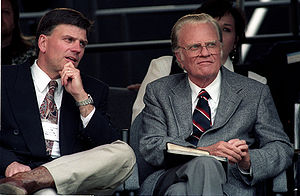
Interview - Franklin Graham

Franklin Graham, son of renowned evangelist Billy Graham, came on The Matt Friedeman Show to talk about his father's newest book, Nearing Home. Below are the "CliffsNotes" of his interview.

Is your father pleased with his legacy?
Of course, I would say yes. He loves his family.

At this stage in life, he takes time with the family; there's family coming to the home almost every day. He's still the head of the family.
What has been his least favorite thing about growing older?

Just not being able to do as much.

One of the unfortunate things is that he's lost the ability to read. Even in doing this book, he had to verbalize it so people could take it down. It was a little bit harder for him to do this.

But his mind is sharp.
What about the best thing?
I think he's got more time to reflect and more time to pray. This is one of the benefits of losing some of your strength; he's able to focus more than when he was fully capable.

He spends some time every day praying for family and friends. He prays for the nation. He's very concerned with the direction our nation is going in the last few years.
There's a chapter in this book called "Don't retire from life". What is that about?
There are a lot of people who just quit. They quit life. They retire and they don't do anything. He wants to encourage people to stay active.

Many older people feel like they're not needed, not wanted; it's important that they get involved.
How does your father feel about the explosion of the gospel in Asia and Africa?
He's just elated. Especially with technology today, we're able to go into countries and take the gospel where it would've never seemed possible.

The Billy Graham Evangelical Society is still pushing that as hard as we can.

Wednesday, November 16, 2011

Ministry Spotlight - Steve Seaton

Steve Seaton is the Executive Director of I Am 4 Kids, a faith-based program that provides one-on-one mentoring for teenagers. He joined The Matt Friedeman Show to talk about his ministry. Below are the "CliffsNotes" of his interview.

Tell us about I Am 4 Kids.
It's so unique. Basically it's just going out and meeting the needs of the community.
We want to go in to these kids who are hurting and bring them wholeness all across the board.

The school system explained to us that they had 50 homeless kids in the high school; they had drugs in the homes, abusive parents.

We went in and just started eating lunch with the kids. After a while, when they found out I was a pastor, they ended up coming to church and giving their lives to Christ.

In 2007, we started to recruit other mentors to help us. Adults will leave work at lunch and go eat with a child in school.

The difference is amazing. The first thing that changes is the self-image. As their insecurity disappears, so do other problems. The truancy goes down.
Do schools not have a problem with your being faith-based?
The reason they don't have a problem is that we just establish relationships, without trying to push anything.

They don't have a problem because we're respecting their boundaries.

We just don't go in and hand them a tract. If we did that, that's proselyting. After several months of mentoring, a light will come on, and the child will ask, "Why are you doing this?"

If they ask, we get to share it. A lot of times, they'll say something and I can share a story about how God changed my life.
Is this something that can work in other places?
Definitely. I'm hoping and praying that once we have this established, we can help this start in other communities.

It's so simple, because all you have to do is find out where there is need, and how you can meet it.
 Your core values are unashamedly Christian. How does sharing your faith work in this situation?
When these kids truly see love, they're going to ask where the source is, and that's when you can share your faith.

Mentoring is imparting character. I want to make sure my mentors are Christians, so they're imparting the right values.

Thursday, November 3, 2011

Ministry Spotlight - Al Proo

Al Proo is Executive Director of Happy Hands, a Oklahoma-based Christian school for children with hearing problems. He joined the Ministry Spotlight to tell us about Happy Hands and their outreach. Below are the "CliffsNotes" of his segment.

Tell us about your ministry.

We serve children from birth to age 6. This is something the Lord showed me I needed to do when I was pastoring a church.

Many of the deaf people I served didn't bring their bibles to church, not because they didn't want to read it, but because they couldn't.
Why do you start so young?
Statistics have proven that 99% of all deaf children are born to hearing parents.

Here's the real gist of the whole matter, is that the child's brain is being mapped. Most parents do not find out their child is deaf until age two and a half.

By that time, the brain has been mapped already.
How do you teach deaf children?
What we do is no different than what we would do with hearing children, except that we make it visual.
How early can they learn sign language?
I know some infants at 8 months who were signing before they can talk.

Science has proved that the children who can sign before they can speak have higher IQs and better reading skills.
Have you seen successes later on in your children's lives?
Some of the children who have graduated high school and gone to college are actually on the student council with hearing students.

Some of them are on the marching bands, and the football and swimming teams.
How can churches do a better job of serving the deaf?
Churches can be familiar with the deaf, make them feel comfortable.

Give them an opportunity to sit close to the pulpit. If they can provide an interpreter for the service, that would be fantastic.

The problem is churches serving children our age, that's where it's more difficult.

That's where Happy Hands comes in. We're not here as Baptists or Methodists, we're simply here to tell them about Jesus.
How do you stay afloat?
90% of our income comes from donations. We are always working hard to get scholarships for our children.

We don't take government funding. We're living in a Red Sea miracle here at Happy Hands.

One reason Happy Hands is here is for us to say, "God did this."

Wednesday, November 2, 2011

Brain Trust - Dave Kinnaman

David Kinnaman is the President of Barna Group.  He is the author of the best-selling book, unChristian: What a New Generation Really Thinks About Christianity, and the Barna report, Teens and the Supernatural.

We have a drop out problem with our youth with regards to church participation, talk to us about it.
Based on our research, of demographics and life span we have found that the least religiously active group is our late teens to early twenties. 
6 out of 10 young people drop out of their faith in between the ages of 18 and 22.
Most of these kids say they loved youth group. What's the deal with that?
We have found that active participation isn't a good indicator as to whether they will stay.  We have found that active discipleship and training is much more significant. 
Many youth groups are simply a social club, in spite of the best intentions of churches and youth leaders.
We need to work harder at understanding how to connect with young people in ways that make a difference.
How important is the parental unit in all of this?
It is the most important factor.  The level of seriousness with which the parents view their faith is the primary factor.  It isn't a foregone conclusion that strong faith of a parent will rub off on a kid.   
Due to our culture changing so much in the past 50 years we are now reaping what we have sown many decades ago. 
How should parents navigate this new cultural reality?  How can we make young people make sense of their faith in this day?
What are some of the things that we can do differently?
Most of these drop outs told us that they never had a solid adult relationship with anyone other than the youth pastor.   
Many do not understand how the Bible applies to their professional abilities or calling.  How do we mentor in terms of vocation or calling?   
Most of this demographic didn't have an understanding of a personal interaction with a real relationship with a Living God.
What are some of the negative perceptions of young people with regards to the faith?
Sometimes, they see the church as anti-science, as anti-intellectual. Sometimes the church just is not cool enough for them. 
 "In the world but not of the world" was how Jesus' prayer for his followers says it.
 I don't think the church is doing a good job of teaching them to be "in but not of the world" with this generation.   
Over-protection often goes against what we are really trying to do.  
We need to have more confidence with this next generation as they face these new challenges.  We must push them toward Christ and a real relationship with him
What is one thing that parents should be doing?
Treat your young people with respect.  They are just as intelligent as you are.  Don't fight wars that God doesn't want us to, but trust Him to work in their lives.

Wednesday, October 26, 2011

Brain Trust - Bruce Wilkinson

Bruce Wilkinson is a popular speaker and author of over 60 books. He joined The Matt Friedeman Show to discuss his latest volume, The God Pocket. Here are the "CliffsNotes" of his interview.

What is the idea behind this book, and why did you write it?
The basic idea of The God Pocket is that God, when He hears people praying with a financial need, wants to help them. He could make money and float it down from heaven, or he could send an angel with some extra cash, but he doesn't do either of those. He wants to partner with people to move in their hearts to give.

The basic idea comes from 1 Timothy, when Paul tells Timothy he wants people to be ready to give and willing to share.

Most people don't understand that God alerts us from heaven of what he wants us to do. 10 out of 1000 people will respond to God's nudging. That's 9990 times that we don't respond.
How do you tell a "God nudge"?
That's a good question. I was speaking on that last night. If you don't know what methods God uses, you'll miss what he's trying to tell you.

A nudge is God moving you to do something unexpected. There are nudges all over Acts. A nudge interrupts you life. It makes you wish you had more information. It's very clear. It makes you uncomfortable. Those are the characteristics of a nudge.

People everywhere have them, a lot, because God is trying to tap on their hearts. God will interrupt your thoughts, to let you know that it wasn't your thought.

People are afraid it might be Satan, but unless it's something sinful, it's not Satan.
Do we need to get more accustomed to God nudges?
We do. And we need to understand the fact that nudges make everyone feel uncomfortable.

Because when you understand that this is how God interacts with people, you are more likely to respond.

The Bible says it is more blessed to give than to receive. When people understand that it wasn't exaggerating, that it really is more blessed to give, they're going to do great things.

You can learn more about Bruce Wilkinson and his ministry at his website.

Wednesday, October 5, 2011

"These children need to be in families, because that's where they're going to thrive. "

Stephanie Scott, who joined the Ministry Spotlight, is the Recruitment Administrator for Camelot Care Centers in Tennessee. Below are the "CliffsNotes" of her interview.

Tell me about Camelot Care Centers.

There are 42 Camelot Care Centers across the country. Our services vary according to what part of the country you're in. I work in the area of child welfare.

For those children who have been removed from the home, our job is to find foster homes for them to live in until they can go back home or until they're adopted.

My hope is to reach out to the faith community to see if we can't do some collaboration to find homes for these children.
Where do you find foster families?
A lot of foster care agencies have been around for a while, and of course the best source for marketing is the foster families themselves.

They have families and friends, and whatever fears those people may have, they're more willing to do it because they see that it's successful.
What makes a good foster parent?
A lot of different characteristics. Some of them are more common-sense. Being flexible, being open-minded. Having a willingness to work with an agency.

Having your friends describe you as confident and self-assured. Being spiritual or religious. All those things are important.

It's also important that you are able to delay gratification, because a lot of these children come in and they're not grateful for the service that you're providing. You have to be able to understand that this is not about you.
What is the biggest challenge foster parents face?
I just got back from attending a conference in Franklin, TN for adoptive parents. I was stunned how many of them said their biggest challenge was a lack of support from their own family. A lot of times they had to rely on each other or their case worker.

And of course, there are some frustrations with the legal system. Some children are returned to the birth family, or have extended visits with the birth family, and that can be a demand.
What motivates foster parents.
I think most importantly is for them to realize that these are children in their communities, right around the corner or several miles down the road, whose needs aren't being met.

Every child deserves a home. And there is someone in that community who can provide that home. It's one of the best things for your own children to see you reaching out like that.
Do you see this working?
We do. That's why I do this work. I was in this for 15 years, and then I took a break before coming back. Most of what's important, the healing that occurs in families, is still the same.

These children don't need to be in group homes. They need to be in families, because that's where they're going to thrive.

Tuesday, October 4, 2011

Low view of the Bible...gets you this

Insight from one of my online students a few summers ago:
I was in a church of a main line denomination last February in East Dayton, OH. The congregation had shrunk from over 1,000 in the 90's to 14 in 2007. The main sanctuary was locked up because they could not light it or heat it for the lack of funds. While I was waiting in the church library I found hundreds of monogrammed and embossed Bibles that were left in the church. I initially thought that they were of old saints that had passed on. I was wrong. These were Bibles that living people had just abandoned as they left the church. It was like an Army, whipped in the field, throwing away their personal equipment to run faster. These people had thrown away their Bibles and left faith period. It is a sad commentary as to the general state of faith outside of evangelical oriented churches. (SG)
Discount the Bible, discount people, discount evangelism. But where there is a high view of scriptural authority (otherwise known as biblical inerrancy) you see spiritual vitality spreading around the world.

Monday, October 3, 2011

"It's important to make your values implicit by the way you live your family life."

Parenting expert John Rosemond is an author, speaker, and columnist who takes a counter-cultural and common-sense approach to parenting.

He came on The Matt Friedeman Show to talk about several parenting topics, including the television and social media. Below are the "CliffsNotes" of his segment.

When is the best time to have the "sex talk" with your child?
That is probably the most bombshell topic you could've brought up. The answer is that it all depends. It depends on at what age your child begins showing interest in the opposite sex, it depends on what peer pressure your child is exposed to.

It's important to make your values implicit by the way you live your family life, the sort of media you allow into your home. You set the example in your relationships with people of the opposite sex.
Does the peer group play a large part in this?
Absolutely. That's what I meant earlier, with the peer group your child associates with. The child who attends today's typical public school needs a talking-to about these issues much earlier than a child who is homeschooled.
What role does TV play in sexuality?
The "between the lines," the subtle, unspoken agenda of the Hollywood crowd is to sexualize children at a very early age. You see that reflected in the content of programs, even those that are advertised as suitable for families.

I am not a television watcher. My wife and I use our TV to watch Fox News and movies. People ask how I get my information, and I'm amazed at the question. Have you ever heard of reading?
What does the emotion of TV do to children?
I think that the emotionality of it, the drama of it, is a factor in the fact that today's young women are so dramatic about their lives. The young teenage girl today has a life characterized by drama.

The dramatic infusion of the lives of today's young teenage women is a great concern to me. It reflects the attitude that their lives are only important when there is drama swirling in their life.

I also think that has a lot to do with their interaction with social media. I think that these media ought to be very closely monitored by parents. 
People say, "When should a child get a Facebook account?" If you want to improve your child's social skills, you don't let them get a Facebook account.
Why do parents struggle with taking strong stances like that?
They believe in the myth that their children will have no friends if they don't allow their children some exposure to the internet, social media, and so on. That is a complete myth. Your child will have better social skills if you don't allow them social media.
Tell me about parent-centered homes.
Children need to learn to pay attention to adults. And you don't pay attention to adults who are constantly paying attention to you. The more attention you pay to your child, the less attention your child will pay to you.

Today's parents don't realize their duty to their child is supervision, not interaction.
 You can find out more about John Rosemond and his work on his website.

Saturday, October 1, 2011

Disparity of the Gospel (World Christian Encyclopedia)

Cost per baptism:

Africa 13,888
Antartica 1,677,852
Asia 61,071
Europe 933,371
Latin America 144,910
Northern America 1,518,991
Oceania 634,479

Full-time Christian workers per million

Africa 1,018.3
Antartica 6,666.7
Asia 185.0
Europe 2,482.6
Latin America 890.7
Northern America 5,399.2
Oceania 3,285.1

A good bit to analyze here. But, for starters - seeing how ripe the mission field in Africa is should we not be spending more laborers to that harvest? North America has more than its fair share of workers with precious little receptivity to the gospel to show for it.

Other points to be made?

Friday, September 30, 2011

Interview: Shawn Carney, 40 Days for Life

Shawn Carney is the executive director of the Coalition for Life, a pro-life organization consisting of 60 churches and thousands of people. He joined The Matt Friedeman Show to promote the ongoing 40 Days for Life. Below are the "CliffsNotes" of his interview.

What is 40 Days for Life?

It started as one simple campaign.  We decided to do 40 days of prayer and fasting, and as a result, the abortion numbers in that community dropped by 48%.

We've been doing it ever since. We have a fall campaign and a spring campaign. It's built on prayer, and going to the places where the abortions actually happen. 
We've had 53 abortion clinic workers have conversions and leave their jobs. We've seen a lot of people overcome that natural fear of going out to pray outside of abortion clinics. It's been a joy.
And all you're asking people to do is show up and pray?
Absolutely. I think it's been the prayerful approach that's been the success of 40 days for life. We're not there to judge the women, we're not there to yell at them. We're there to give them a better option for their baby. And we're there for the workers as well.

It's wonderful to see what God is doing. We have a record 301 cities this year. 46 of those are new, including cities in Puerto Rico, Argentina, and Germany.
You can learn more about 40 Days for Life, including how you can get involved, at their website.

Author Interview: Dr. Paul White

Dr. Paul White is a psychologist, author, speaker, and consultant who specializes in workplace relationships. He joined The Matt Friedeman Show to discuss his latest book, The Five Languages of Appreciation in the Workplace. Here are the "CliffsNotes" of his interview.

Does this book have any connection to The Five Love Languages?
It does. Dr. Chapman and I wrote this book together. We've been working for the past year to work the love languages around the workplace. 
We wanted to provide practical resources to help managers and coworkers relate to one another better.
How can we show appreciation in the workplace?
There's a big issue going on right now in that over 65% of people say they haven't heard any appreciation in the last six months, whereas managers say they're making efforts to affirm them. The messages that are being sent aren't getting there.

Different elements have to be there in order for people to feel appreciated. The five love languages in the workplace have the same names; Words of Affirmation, Quality Time, Gifts, Acts of Service, and Physical Touch.

We've developed an inventory that goes along with the book, so people can find out what their languages are. We then get that to their supervisor so they can take that information and use it to build up the employees.
Could it be adapted for use in the church?
Absolutely. We wrote it with that in mind. We wrote a chapter on encouraging volunteers. We want to apply this to churches, to ministries, non profit organizations, to schools. We know that we can encourage and show appreciation in ways that make them feel valued.

One of the things we've done is work this in a way that doesn't cost a lot of money. What matters are just small things that let them know you care about them. If they're sports fans, get them an SEC magazine. Buy them a cup of Starbucks.

Our inventory helps specify what each person needs, so you can hit the mark and help them feel appreciated.
Does this increase job satisfaction?
Absolutely. We increase customer satisfaction. We decrease staff conflict. Employees report that they enjoy coming to work more.
To learn more about Dr. Paul White and his work, you can visit his website.

Pastor's Circle - Randy Frazee

Randy Frazee is the senior minister of Oak Hills Church in San Antonio, TX. He joined the Pastor's Circle to discuss his newest book, The Heart of the Story. Below are the "CliffsNotes" of his interview.

Tell us about your book.
I think that one of the biggest drives for me to write this book is that we've discovered that biblical illiteracy is a growing epidemic among Christians. As we've gone into the 21st century, research shows that Christians are more illiterate about their faith than agnostics or atheists.

Christians often see the Bible as a set of disconnected stories. This book tries to connect the dots, so everything is connected in one overarching love story of God.
Tell us about that "overarching" story.
There's two "stories" going on with the Bible, the upper story and the lower story.

For instance, in the story of Joseph, you may get a great lesson on forgiveness, or resisting temptation. But God uses Joseph in the upper story, to save his family from famine and continue to live the plan for God's people.

This is one of the greatest applications. We are characters in God's unfolding upper story. If we align our life to that upper story, everything will come out for good.
What is the "heart of the story"?
I would say that the heart of the story is what you see in Genesis 1 and 2. God coming down and doing life in community with Adam and Eve. If you fast-forward to the end of Revelation, you again see the Tree of Life, and God coming down to live among us.

God's upper story plan is going to happen. The only question is whether we will participate with blessing or without it.

A lot of the time, the lower story gives you practical advice for the day, while the upper story gives you the long view of God's vision for us.
 You can learn more about Randy Frazee and The Heart of the Story on his website.